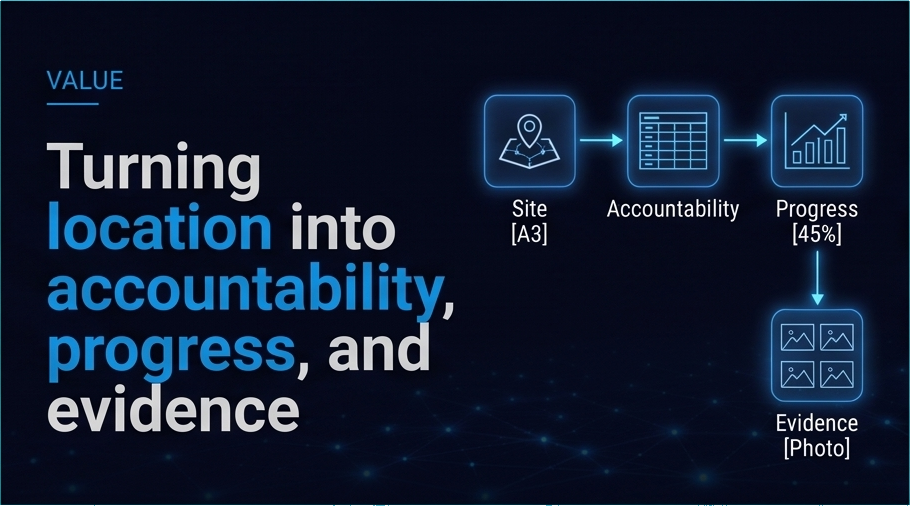
Most project reports answer how many. How many inspections are open? How many punch items remain? How many RFIs are overdue? How many observations have not been corrected? Counts are useful, but they rarely tell a project leader where the risk is concentrated or what work is actually being affected.
Location changes the question. Ten open items across a million-square-foot project may be manageable. Ten open items in the same electrical room, life-safety zone, turnover area, or ceiling close-in sequence may represent a serious constraint. The number did not change. The meaning did.
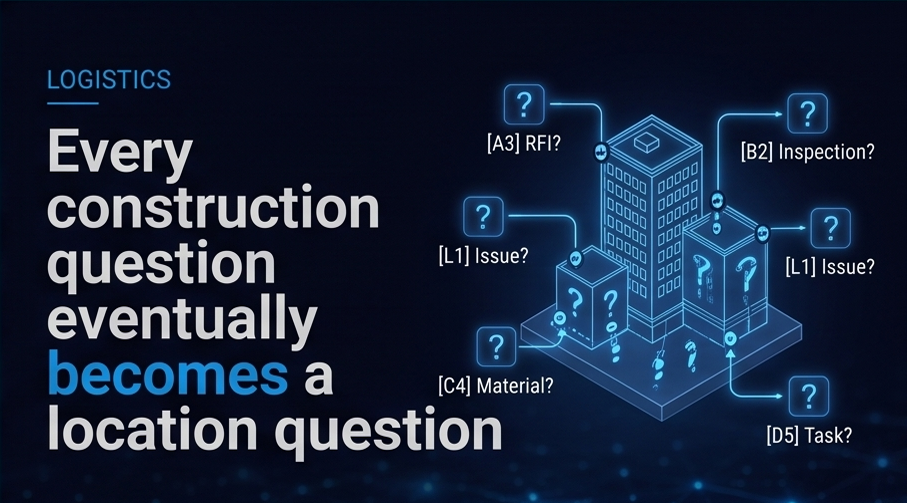
Blade's Location Breakdown Structure turns location into a consistent analytical dimension. Any project record can be linked to one or more LBS nodes. An inspection can span multiple rooms. An observation can identify a primary location while maintaining related areas. A form, punch item, issue, RFI, or piece of evidence can remain attached to the exact part of the project it concerns.
Once that connection is governed, reporting becomes more useful. Teams can filter by building, level, wing, zone, area, unit, room, core, or bay. Detailed records can roll up through the hierarchy. A project executive can begin at the building level, identify a floor with elevated risk, move into a zone, and then review the individual records and evidence creating the condition.
This supports stronger progress management. A location can provide the organizing context for schedule activities, installed work, inspections, quality status, and outstanding constraints. The team can ask whether an area is truly ready-not merely whether a task was marked complete. If work is installed but the required inspection is missing, the location tells a different story. If the inspection passed but a connected issue remains unresolved, readiness may still be incomplete.
Accountability becomes clearer because assignments arrive with complete spatial context. A trade partner can see not just 'Room 201,' but the full path through the building and level. The responsible team can locate the work faster, review related records, and provide evidence at the right place. Project managers can identify whether delays are isolated, repeated across similar spaces, or associated with a particular sequence or system.
Quality teams gain another important advantage: pattern recognition. When failures are attached to governed locations, teams can compare recurring conditions across rooms, units, zones, floors, or buildings. A repeated above-ceiling deficiency may point to a trade-wide installation issue. Failures concentrated in one sequence area may indicate supervision, access, material, or coordination problems. Location helps move the conversation from individual defects to systemic improvement.
Blade also recognizes that buildings are not purely horizontal trees. Shafts, risers, stairs, and other vertical conditions continue through multiple levels. The Primary LBS remains a clean hierarchy for containment, while Vertical Zones can represent cross-level continuity. A shaft can relate to several levels and spaces without being duplicated or forced into one misleading branch of the tree.
Within a level, vertical segmentation can distinguish occupied space, ceiling plenum, floor plenum, and full-height conditions without creating unnecessary tiers. That precision matters for MEP coordination, inspection targeting, and reporting. An issue above the ceiling is not the same as an issue in the occupied room below, even when both share the same room boundary on plan.
For owners and clients, the result is a more defensible evidence layer. Decisions can be supported by the requirement, location, field response, photograph, issue, corrective action, and verification. Turnover information can remain organized around the facility's actual spaces. Warranty teams can navigate back to the place, system, and history associated with a request.
Location does more than help users find a record. It reveals relationships between work, risk, progress, and evidence. That is what allows project leaders to move beyond counting records and start understanding the condition of the project.