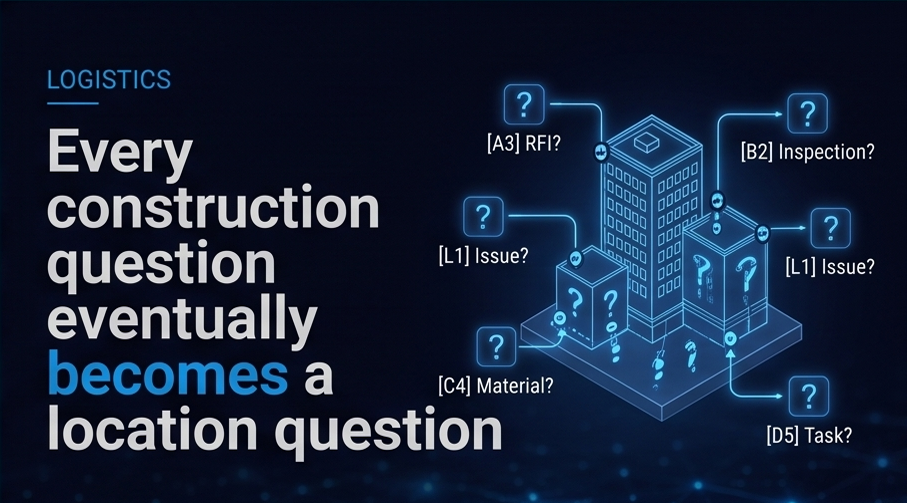
Construction teams spend their days asking questions that appear to be about documents, people, schedule, quality, cost, or risk. Which detail is current? What has been inspected? Where is the failed work? Which areas are ready? What is holding up close-in? Who owns the correction? Yet almost every one of these questions eventually depends on the same missing piece of context: where on the project is this happening?
Location sounds simple until a project tries to use it consistently. The superintendent may say Level 2 East. The drawing may call the same area Area B. The model may use a room number. The schedule may divide the floor into work zones. The subcontractor may refer to a pour, grid line, shaft, unit, or sequence. Every description can be reasonable, but the differences make it difficult to connect the information.
That inconsistency creates friction everywhere. An inspection is completed but cannot be compared reliably with progress. A punch item is assigned to a room name that changed. An RFI affects a shaft across several levels, but the issue is attached to only one floor. A report counts open items without showing where they are concentrated. The information exists, but the project lacks a governed spatial language for bringing it together.
Blade's Location Breakdown Structure, or LBS, establishes that language. It defines the 'where' dimension of the project through a controlled hierarchy that reflects how the project is actually organized. A team can structure the project by building, level, section, wing, department, zone, area, unit, suite, room, sub-room, corridor, core, bay, or another controlled spatial type appropriate to the work.
The objective is not to force every client into the same terminology. Blade separates stable system meaning from the labels people see and use. One organization may call a tier Floor while another calls it Level. A hospital may organize work through departments and wings. A multifamily project may rely on units. A warehouse may use bays and zones. The client retains familiar project language while Blade maintains the consistent structure required for integrations, reporting, and automation.
Each location also carries its full path through the project. Room 201 is no longer an isolated text value. It can be understood as part of Building A, Level 2, East Wing, and a particular department or zone. That full path makes names less ambiguous, improves search and filtering, and allows information to roll up from a detailed space to a floor, building, or project-wide view.
This matters for every participant. Field teams can find the correct location without interpreting multiple naming systems. Project managers can see open work by floor, zone, or area. Quality teams can identify recurring failures in similar locations. Owners can understand readiness and risk using the operational structure of the facility. Trade partners receive assignments with enough spatial context to act without another phone call.
A governed location structure also protects the value of project history. Names and organization can evolve, but the underlying location identity and relationships remain stable. Records can stay connected to the place they were created for, even as templates, reports, and workflows change. That continuity is especially important during turnover, warranty, and later facility operations.
Blade supports a Primary LBS as a strict, non-duplicative hierarchy: each location has one parent and one clear path. That simplicity is intentional. The core hierarchy represents containment-where something belongs-not every possible geometric or operational relationship. More complex relationships, such as adjacency, service, intersection, or cross-level continuity, can be connected through relational and graph layers without corrupting the core location structure.
For the client, the value is not the hierarchy itself. The value is what becomes possible when drawings, forms, model elements, RFIs, inspections, punch items, observations, schedule activities, and reports can all reference the same governed version of where. The project becomes easier to navigate, easier to measure, and easier to explain.
Location is not another field in a database. It is one of the primary organizing dimensions of construction knowledge. When the project agrees on where, Blade can begin connecting everything else that happened there.