Construction's language problem
Every construction project produces an enormous volume of information, but volume is not the same as understanding. Drawings, models, specifications, schedules, estimates, submittals, RFIs, inspections, daily reports, photographs, contracts, and change records may all describe the same work from different perspectives. Yet each discipline, company, and software solution tends to organize that information differently.
An architect may describe a door as a scheduled design element. The estimator sees an assembly and cost code. The scheduler sees an activity or constraint. The superintendent sees an installation sequence and field condition. The inspector sees a requirement and evidence. The owner sees an asset that must be operated and maintained. None of these perspectives is wrong. The problem is that the connections among them are rarely made explicit.
As a result, teams can use the same words while telling different stories. 'Complete' might mean modeled, coordinated, procured, installed, inspected, commissioned, or accepted. 'Level 2' might refer to a drawing location, a schedule breakdown, a cost code segment, a model parameter, or an owner asset hierarchy. Human beings resolve much of this ambiguity through experience and conversation. Systems usually cannot.
What an ontology actually does
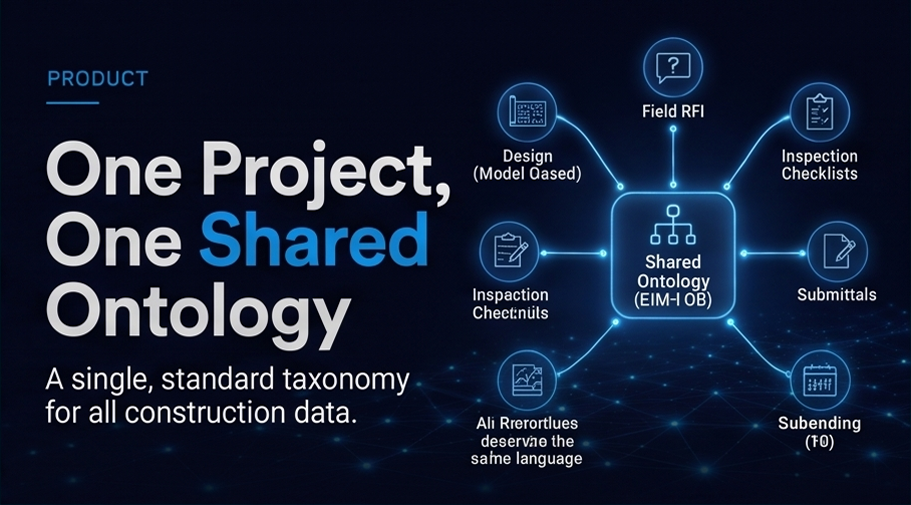
An ontology is a formal structure for defining the concepts in a domain and the relationships among them. In construction, it establishes a shared vocabulary for the things a project contains: projects, sites, buildings, levels, zones, rooms, systems, assemblies, assets, documents, requirements, activities, companies, roles, issues, approvals, inspections, and evidence.
The critical word is relationships. A dictionary can define a door. An ontology can describe that a door is located in a wall, connects two spaces, belongs to a type, appears in a schedule, is represented in a model and drawings, has hardware and fire-rating requirements, is supplied and installed by responsible parties, participates in activities, requires inspections, and becomes an owner-maintained asset.
That connected definition gives every participant a common frame of reference without erasing their specialized view. The estimator can still work in cost structures and the scheduler in activities. The ontology supplies the bridge that says which scope, objects, locations, requirements, and records those structures describe.
A shared story across the lifecycle
A well-defined ontology creates continuity from early planning through operations. During preconstruction, it can relate estimate items, scope packages, design assumptions, locations, and risks. During VDC, it can connect model objects, clashes, coordination decisions, penetrations, clearances, and work packages. During construction, it can link installed work to drawings, submittals, RFIs, inspections, photographs, and schedule status. During handover, it can organize warranties, commissioning results, training records, and maintenance requirements around the assets the owner will operate.
This continuity prevents the project from repeatedly losing and rebuilding context. Today, information often crosses a boundary by being exported into a new format. An estimate becomes a budget. A coordination issue becomes a field note. A model object becomes a line on a drawing. An inspection becomes a PDF. A submittal becomes an attachment in a closeout folder. At each transition, relationships are flattened and meaning is discarded.
With an ontology, those artifacts can remain distinct while referring to the same governed project concepts. The door does not become a different door because it appears in another system. The room does not change identity because one solution calls it a location and another calls it a space. The project retains one connected story.
Governed concepts matter more than uncontrolled labels
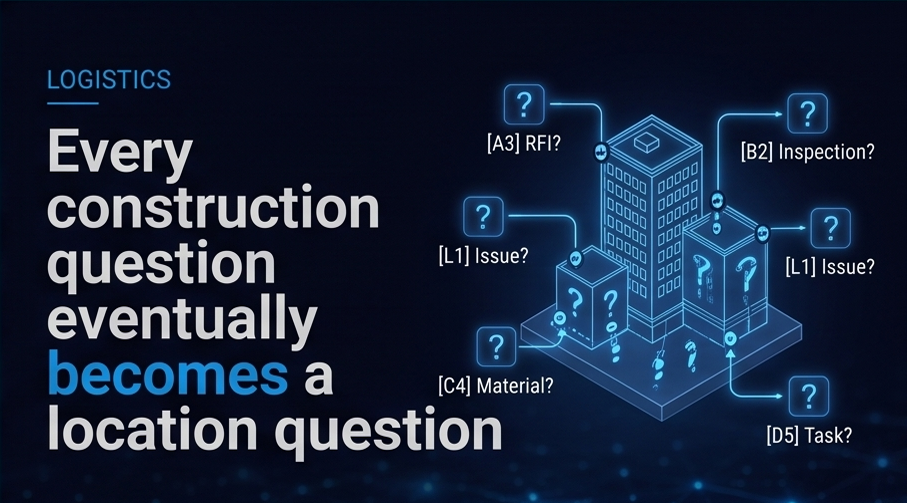
An ontology is only useful when its core concepts are governed. Construction teams are skilled at creating labels quickly, but uncontrolled naming produces duplicate and conflicting meanings. One team enters 'Electrical Room 201,' another 'Elec. 201,' and another 'Room 02-201.' A person can often infer that they refer to the same place. At project scale, those variations fracture reporting, search, automation, and auditability.
Governance does not mean that every description must be rigid. It means important objects receive persistent identity, agreed classifications, ownership, and controlled relationships. A location can have several human-readable names while retaining one identity. A piece of equipment can be reclassified or renamed while preserving its history. A requirement can be revised without losing the version under which earlier work was performed.
This is especially important when contractual records are involved. The system must distinguish between a current interpretation and the record that was authoritative at a particular time. A strong ontology does not merely connect information; it supports provenance, versioning, responsibility, and evidence.
The foundation for interoperability
Construction will never run on one software solution. Owners, designers, general contractors, specialty contractors, manufacturers, and authorities will continue to use different tools. Interoperability therefore cannot depend only on moving files or matching column names. It requires agreement about meaning.
When two systems understand that a model space, drawing room, schedule location, inspection area, and owner asset location represent the same governed place, information can move with context intact. When an RFI response changes a requirement, the project can identify the related detail, model objects, submittal, activities, inspections, and installed work. When a submittal is rejected, affected procurement and installation commitments can be surfaced before the consequence grows.
The ontology becomes a translation layer across the technology stack. It does not replace existing systems; it allows them to participate in a larger, coherent model of the project. This is how disconnected records become a data fabric rather than another document repository.
The foundation for trustworthy AI
AI makes the need for an ontology more urgent. Large language models can summarize text and identify patterns, but construction decisions require more than fluent answers. A system must know whether a document is current, which project and location it governs, what object it describes, who approved it, what changed, and which evidence supports the conclusion.
Without a defined ontology, AI is forced to infer those relationships repeatedly from incomplete context. It may produce an answer that sounds reasonable while joining the wrong revision, room, equipment type, or requirement. An ontology narrows that uncertainty by giving the AI governed concepts and explicit relationships on which to reason.
This does not remove the need for human oversight. It makes oversight more effective. A reviewer can see not only an answer, but the chain of project objects, records, and evidence used to produce it. Confidence becomes tied to the quality and completeness of relationships rather than the persuasiveness of generated language.
Start with the questions the project must answer
A useful construction ontology should not begin as an academic exercise to model everything. It should begin with operational questions. What changed? Where does it apply? Who is responsible? What work is affected? Has it been approved? Has it been installed? Has it been inspected? What evidence proves the status? What must the owner receive at turnover?
From those questions, teams can define the essential concepts, persistent identifiers, classifications, relationships, and governance rules. The structure can expand as new use cases require it. The objective is not theoretical perfection. It is shared understanding that survives across disciplines, systems, and phases.
Construction has spent decades digitizing documents and individual workflows. The next step is to connect the meaning inside them. A well-defined ontology gives every participant the ability to contribute to the same project story-even when they use different tools, perform different work, and see the project through different professional lenses.